




Akash Network proposes AKT migration to Solana original editorial illustration
Akash Plans One-Way AKT Migration to Solana With a Two-Year Claim Window
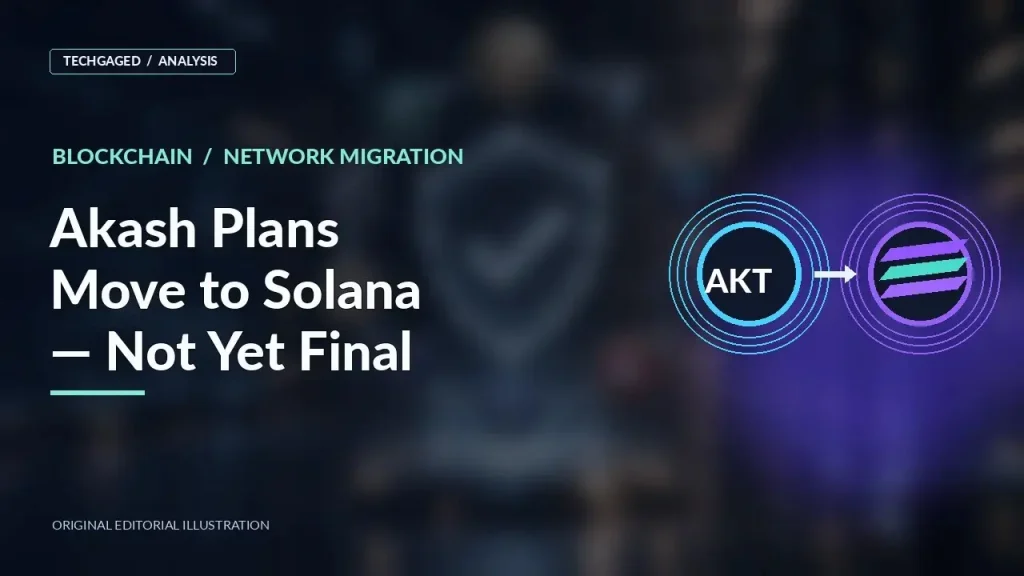
Akash Network’s core team has selected Solana as its preferred destination for a proposed migration away from a standalone Cosmos SDK blockchain. Technical planning documents reviewed by TechGaged outline more than a simple token swap: the project’s decentralized computing marketplace, token economics and operational infrastructure would have to move through a staged transition subject to governance approval and security checks.
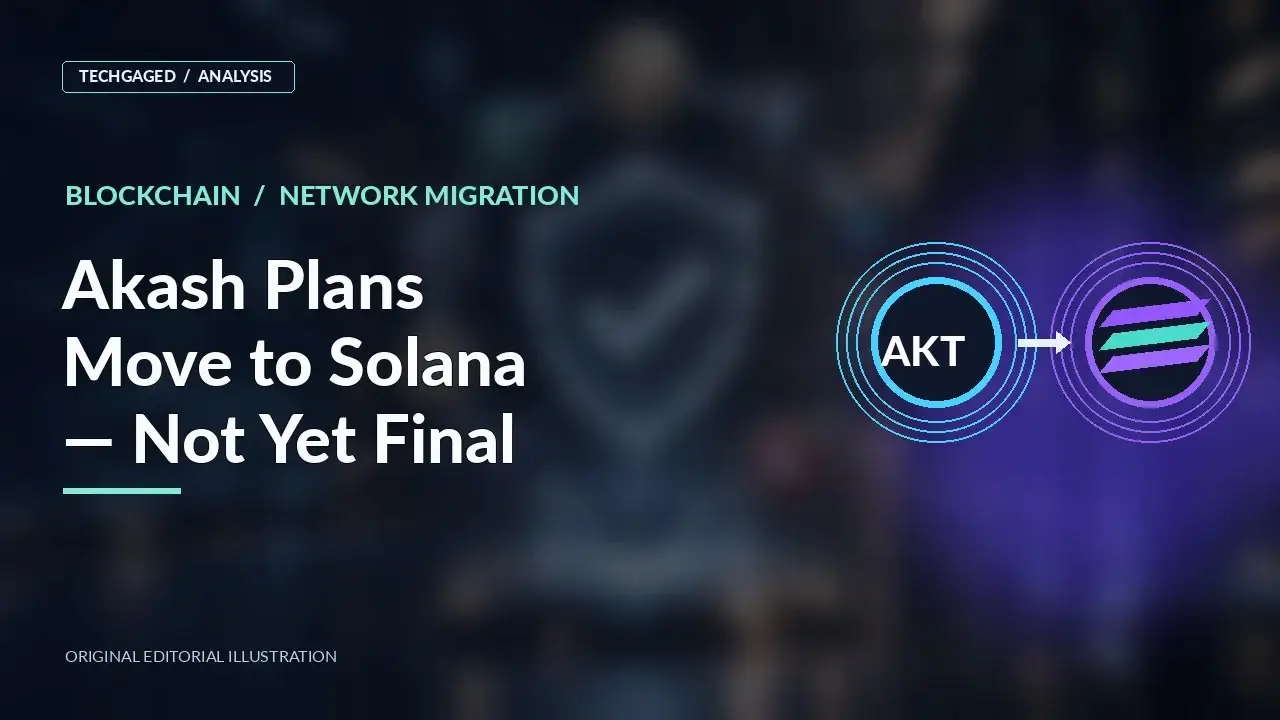
The proposal entered Akash’s public governance discussion forum on October 26, while the accompanying Akash chain migration specification identifies Solana as the core team’s preferred route. An Ethereum-compatible alternative is documented for comparison, but is not currently the selected path. Crucially, the technical documents are marked draft, and a team preference is not equivalent to a passed on-chain migration vote.
Akash operates a decentralized marketplace for computing resources. Its AKT token has been associated with governance, staking and the economic mechanisms of the Cosmos-based network. A successful migration would therefore affect users, validators, infrastructure providers, token holders and exchanges, rather than merely changing which wallet displays the asset.
Latest Stories
Lisk Chain Shuts Down on November 2: What Happens to Stranded Crypto Assets?
Ethereum Delays Glamsterdam Test on Hoodi as Developers Review Gas-Rule Interactions
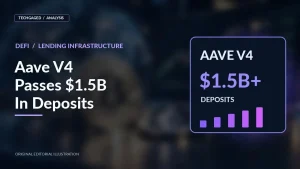
Aave V4 Passes $1.5B in Deposits as External Curated Markets Expand
A one-way AKT migration and a two-year portal
The current draft token-migration plan calls for AKT to become a Solana SPL token if the required proposal passes. Under its proposed schedule, the new token and a one-way migration portal would launch seven days after the governance vote ends. The portal would allow holders to remove AKT from circulation on the old chain and mint a corresponding amount on Solana. The draft specifies a two-year window, extendable by a further governance decision.
For holders, the one-way design is material. Once an old-chain balance is migrated and represented on Solana, the plan does not provide a reverse migration service. The documents also describe a 14-day unbonding requirement for currently staked or unbonding AKT before the tokens can be moved.
These are planned operating parameters—not services already open to the public. The specification requires token and portal security audits, testing, exchange coordination and a formal launch-readiness gate before the binding migration proposal is submitted. Its rollout section explicitly prohibits treating a governance proposal as a substitute for readiness testing.
The old chain would not disappear the day AKT first becomes available on Solana. The plan separates the token launch from the marketplace’s eventual cutover, then envisages a 90-day wind-down period after that cutover before the legacy chain halts. The approach aims to give participants time to move positions and operational services, while creating a period in which both old and new environments must be secured and monitored.
Why the token mechanics matter more than the headline
Moving a marketplace from a sovereign chain to Solana could change operating costs, transaction handling, validator responsibilities and how application developers integrate with the network. But it also concentrates risk in migration contracts, proof of asset removal, distribution through exchanges and support for users who miss the transition window. Those are implementation and security questions, not automatic benefits of adopting a faster settlement network.
The draft includes a particular concern about supply accounting. A correct migration mechanism must prevent an AKT balance from remaining spendable on the old chain while an equivalent balance is minted on Solana. The published documentation leaves some implementation decisions and risk controls open, showing why a plan should not yet be treated as a finished technical system.
Investors should also separate a governance initiative from price-impact predictions. A proposal to move AKT onto Solana does not guarantee increased trading volume, new exchange listings or appreciation in either AKT or SOL. Those outcomes would depend on execution and subsequent demand.
The next decisive evidence will be a completed security-readiness process followed by a formally submitted and approved on-chain vote. Until then, Akash’s Solana migration remains a concrete, publicly documented proposal rather than a completed network transition.
How do you rate this article?
Subscribe to our YouTube channel for crypto market insights and educational videos.






Join our Socials
Briefly, clearly and without noise – get the most important crypto news and market insights first.
Most Read Today
1
Elon Musk’s SpaceX Unveils Massive Bitcoin Treasury Ahead of IPO
2A Rare Ethereum Trend Is Emerging as Long-Term Holders Keep Taking Losses
3Aave Liquidates Hacker’s Positions on Ethereum and Arbitrum
4Bitcoin Is Now Less Volatile Than Nvidia, Says Bitwise CIO
5Bitcoin May Not Be Cheap Until $46,457, CVDD Warns
Latest





8
Also read
Similar stories you might like.
Crypto News
Solana’s Real-World Assets Surge to a Record — Is a Bigger Growth Phase Ahead?
Azeez | 2026-10-30

Crypto News
What Would Solana’s Consensus Look Like in a Post-Quantum World?
Azeez | 2026-10-28
Crypto News
Altcoin Speculation Retreats From September Highs: What It Means for Buyers
Azeez | 2026-10-27

Crypto News
SOL Gets a Major Network Upgrade as Alpenglow Goes Live
Azeez | 2026-10-22

Crypto News
Solana Could Become the World’s Fastest Blockchain After This Upgrade
Azeez | 2026-10-14

Crypto News
Cosmos Community Weighs Return of 1.227 Million ATOM Recovered After Neutron Exploit
TechGaged | 2026-10-04
Crypto News
Solana’s RWA Surge Hits Another Record as Total Value Tops $4.6B
Azeez | 2026-09-24

Crypto News
Solana Is Becoming a Key AI Payment Network: A Bigger Shift Is Unfolding
Azeez | 2026-09-22

Crypto News
Solana Could Be Building Toward a Parabolic Move
Azeez | 2026-09-18

Crypto News
Solana’s dApp Economy Is Back Near Its 2025 Peak — The Next Move Matters
Azeez | 2026-09-14