







Bitcoin Core 32.1 network node software editorial illustration
Bitcoin Core 32.1 Reworks Transaction Relay and Adds New Privacy Protections
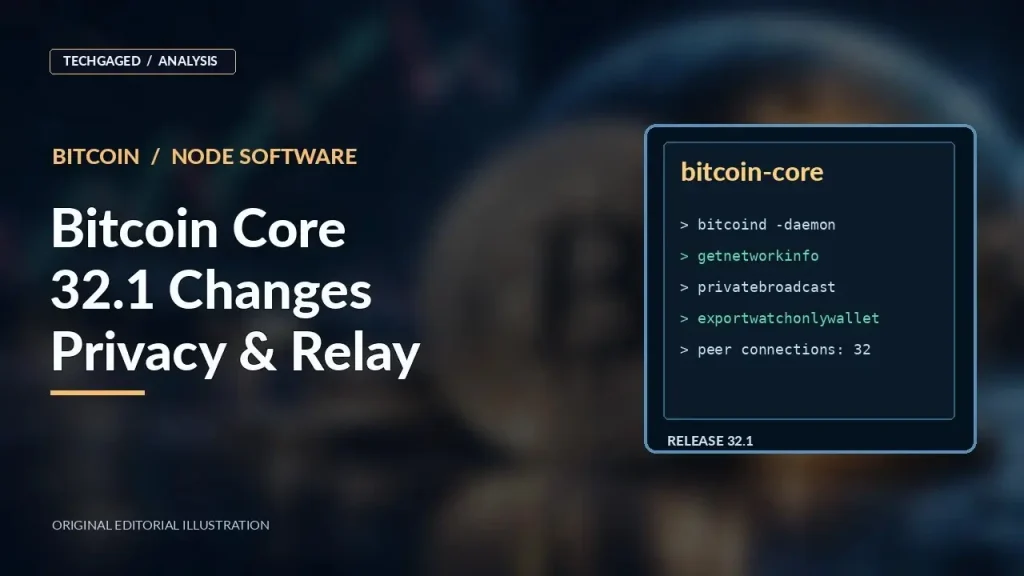
Bitcoin Core 32.1 is available, bringing changes to how Bitcoin nodes relay transactions, handle private broadcasts, manage certain wallet functions and expose diagnostic data. For node operators, the update is a reminder that the privacy and resilience of Bitcoin depend not only on its consensus rules but also on the software used to communicate with peers.
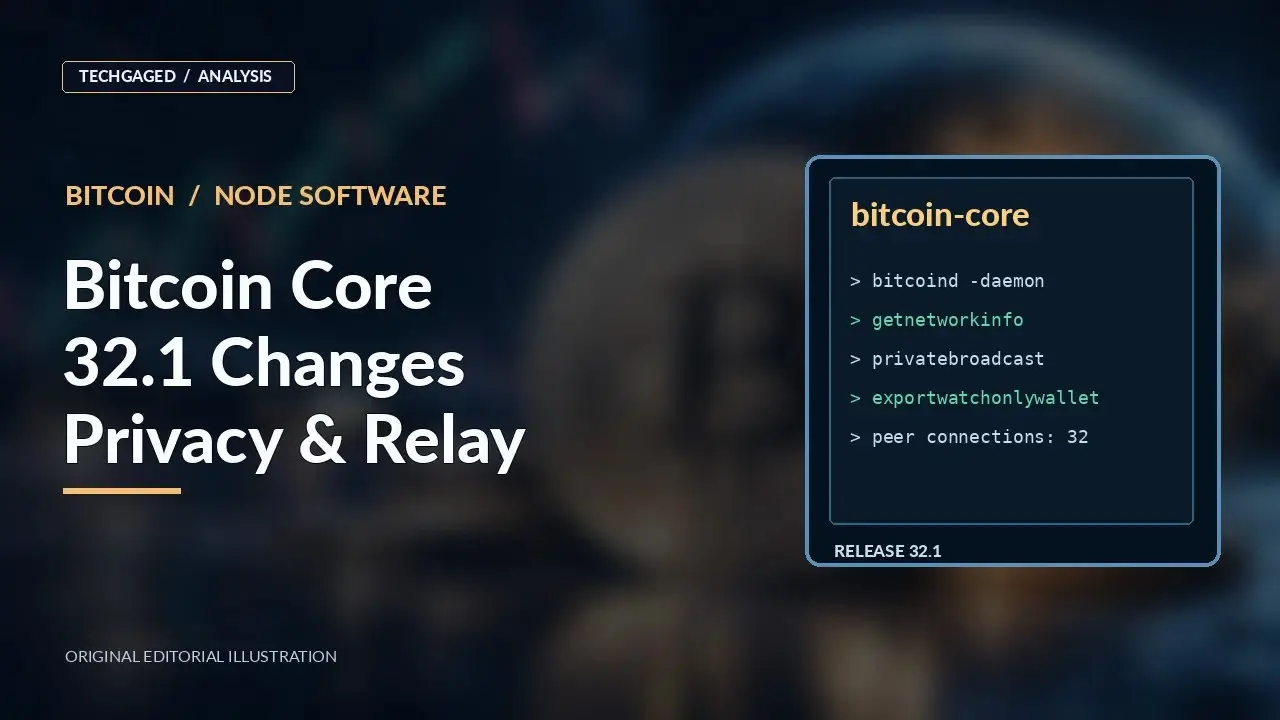
The official 32.1 release notes say the version includes new features, bug fixes and performance improvements. Bitcoin Core also states that 32.0 was tagged but never fully announced or released because of last-minute issues. Users should therefore regard 32.1 as the available release rather than assume there was a normal production upgrade path through 32.0.
The announcement makes another lifecycle distinction: version families 29.x and older have reached end of life and will no longer receive updates. That does not automatically make those nodes unable to validate blocks, but it does change the risk profile for operators who expect continuing bug fixes and security maintenance.
Latest Stories
Ireland Fines Coinbase €3.25M for Safeguarding Failures: Regulator Details Underfunded Accounts

Coinbase Prediction Markets Cross $200M Run Rate as Q3 Reveals Softer Crypto Trading

Lisk Chain Shuts Down on November 2: What Happens to Stranded Crypto Assets?
Private broadcasts and traffic controls receive attention
Among the notable changes is a fix for a possible leak of the transaction originator’s IP address when a node uses the sendrawtransaction interface with -privatebroadcast=1. This is relevant to users attempting to reduce network-level information leakage; it should not be misread as making all Bitcoin transactions private or untraceable.
The software also limits private-broadcast queues to 10,000 pending entries and each such transaction to 1,000 send attempts, after which the operator must choose how to retry or clear a stuck entry. These bounds are operational safeguards that trade uncontrolled resource consumption for explicit failure handling.
For ordinary outgoing transaction relay, the notes describe a move to a global backlog rather than a per-peer rate limiter. The default remains 14 transactions per second, boosted for outbound peers, while a second bandwidth limit of 12 megabytes per ten minutes has been added. Node operators should review how those defaults interact with network demand and their own configurations.
Tor hidden services generated by Bitcoin Core will use proof-of-work defenses when supported by the Tor daemon. This is not Bitcoin mining and should not be confused with the energy expenditure used to validate blocks; it is a protective mechanism relevant to resisting abuse against network connectivity.
Wallet operators get practical new tools
Bitcoin Core 32.1 introduces exportwatchonlywallet, allowing a descriptor wallet to export information needed by an online watch-only installation without exporting private keys. That can support safer workflows in which signing keys remain in a separate environment while a connected machine watches transactions and prepares requests for signing.
New interfaces include addhdkey and derivehdkey for advanced hierarchical deterministic key management, plus machine-readable RPC discovery through OpenRPC. The developer documentation makes clear that adding an extended key does not automatically activate it for spending unless the relevant descriptor is imported.
There are also behavior changes that automation scripts may need to accommodate, including stricter RPC input checking, new connection limits and revised logging categories. Nodes built from source should consult the platform-specific release guidance before rolling out changes to mission-critical systems.
The official project directs users to reproducibly generated, signed downloads from its release directory, not unverified third-party installers. A careful upgrade means backing up wallet data, reviewing configuration compatibility, verifying downloads and testing any wallet-creation or transaction-broadcast integrations.
This is an important technical release, not a promise of faster block confirmation, higher BTC prices or a new consensus rule. Its effects are concentrated in node operation, network behavior, privacy handling and developer tooling—the less visible infrastructure on which the wider Bitcoin ecosystem relies.
How do you rate this article?
Subscribe to our YouTube channel for crypto market insights and educational videos.






Join our Socials
Briefly, clearly and without noise – get the most important crypto news and market insights first.
Most Read Today
1
Elon Musk’s SpaceX Unveils Massive Bitcoin Treasury Ahead of IPO
2A Rare Ethereum Trend Is Emerging as Long-Term Holders Keep Taking Losses
3Aave Liquidates Hacker’s Positions on Ethereum and Arbitrum
4Bitcoin Is Now Less Volatile Than Nvidia, Says Bitwise CIO
5Bitcoin May Not Be Cheap Until $46,457, CVDD Warns
Latest






8
Also read
Similar stories you might like.

Bitcoin
Bitcoin’s White Paper Turns 18: The Trust Problem Crypto Exchanges Still Face
TechGaged | 2026-11-02
Crypto News
Grayscale’s Zcash ETF Attracts $14.8M — Could Investor Appetite Be Shifting?
Azeez | 2026-10-31

Crypto News
Bitcoin’s 2023 Playbook Is Repeating — Could Volatility Be Ready to Return?
Azeez | 2026-10-29

Crypto News
Bitcoin’s Comeback Against the S&P 500 Could Trigger a Bigger Rotation
Azeez | 2026-10-28

Crypto News
Bitcoin Loses 30K Wallets in Days as Smaller Holders Lose Patience
Azeez | 2026-10-27

Crypto News
Bitcoin Retail Deposits Surge as Whale Behavior Signals a Growing Market Divide
Azeez | 2026-10-26

Crypto News
Bitcoin Faces a Double Macro Challenge as Oil Prices Stay Above $100
Azeez | 2026-10-23

Crypto News
Bitcoin Is Back Above Treasury Cost Basis — But the Biggest Buyers Remain Cautious
Azeez | 2026-10-22

Crypto News
JPMorgan Ranks Bitcoin Above Stocks and Gold — But Warns of 55% Volatility
Azeez | 2026-10-21
Crypto News
Zcash’s New Privacy Proposal Could Give ZEC a Fresh Catalyst
Azeez | 2026-10-20