






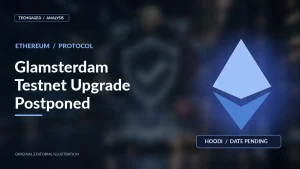
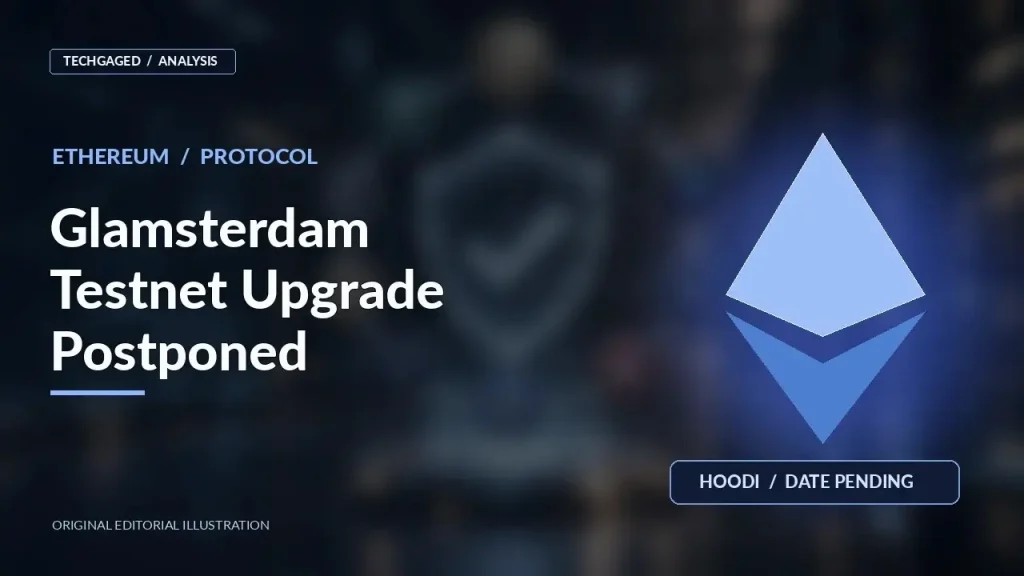
Ethereum Glamsterdam Hoodi testnet postponement editorial illustration
Ethereum Delays Glamsterdam Test on Hoodi as Developers Review Gas-Rule Interactions
Ethereum’s Glamsterdam upgrade did not activate on the Hoodi testnet on October 26 as previously planned. Developers postponed the network change to investigate how proposed state-creation gas pricing might interact with contracts already deployed on mainnet. As of the latest published Ethereum Foundation protocol notice, no replacement Hoodi activation date has been set.
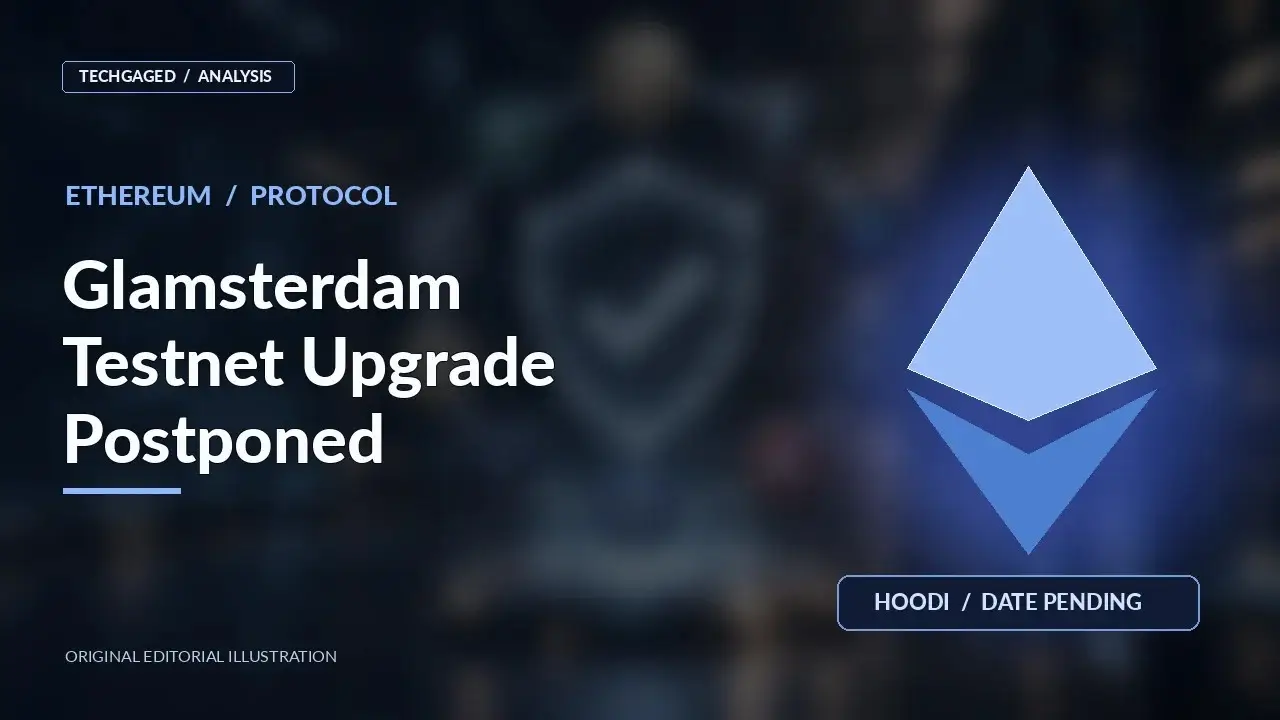
The October 22 postponement notice says core developers made the decision at their All Core Developers Execution meeting, ACDE #248. The immediate concern involved EIP-8037 and its interactions with existing smart contracts. The delay therefore reflects a compatibility review, not a claim that the Ethereum mainnet has suffered a consensus failure.
The revised plan removed the Amsterdam execution-layer and Gloas consensus-layer activations from Hoodi’s earlier schedule. It also canceled the previously scheduled increase of Hoodi’s gas limit to 200 million at the same epoch. The Ethereum Foundation has explicitly said the change does not roll back Hoodi’s existing chain history.
Latest Stories
Hanwha Selects Chainlink for Global Tokenized Assets Ahead of Korea’s 2027 Rules

Ripple Wins Final US Trust Bank Approval, but RLUSD Issuer Remains Unchanged

Chainlink Launches 24/7 Pricing for Tokenized Stocks as Aave Addresses Weekend Risk
Why a gas-pricing change needs more testing
Glamsterdam includes a group of improvements intended to help scale Ethereum Layer 1 while keeping validation practical. Its earlier technical announcement describes enshrined proposer-builder separation, block-level access lists and changes to the way transaction execution and state growth are priced.
The state-creation element matters because writing new persistent data imposes costs that extend beyond the execution of one transaction. A gas schedule that better accounts for these costs can help align demand with long-term network resources, but altering prices may surprise software written against earlier assumptions.
Developers may have constructed contracts using particular gas stipends or estimates for sequences of calls. Even if those contracts remain valid, changing costs can cause operations to run out of gas or become uneconomic. That is why testing compatibility with mainnet contracts before activation is an engineering requirement rather than a sign that scaling has been abandoned.
The Glamsterdam design also includes block-level access lists to help clients validate and access state more efficiently, along with proposer-builder separation that changes block production duties. These features require coordinated software updates across execution and consensus clients.
What node operators and ETH holders should know
The Foundation has instructed Hoodi node and validator operators to check that their execution and consensus client versions reflect the postponed activation. Running software that still assumes the obsolete October 26 schedule could lead to incompatible expectations during a network change.
This requirement is specific to the Hoodi testnet. The announcement says no action is required from ordinary Ethereum mainnet users or ETH holders because of the postponement. The testnet delay does not constitute a new mainnet deadline: the Glamsterdam mainnet schedule was already undecided and remains so.
For market participants, the correct interpretation is that an upgrade milestone has been moved to allow further investigation. It is not sound to attach an invented ETH price target to the timing decision or imply that a canceled Hoodi gas-limit increase has changed mainnet transaction fees.
Developers can continue testing potential changes with current specifications and client release notes, but should not treat outdated timetable tables as authoritative. The next important event will be a confirmed replacement epoch, accompanied by updated client guidance and clear documentation of the EIP-8037 compatibility findings.
How do you rate this article?
Subscribe to our YouTube channel for crypto market insights and educational videos.






Join our Socials
Briefly, clearly and without noise – get the most important crypto news and market insights first.
Most Read Today
1
Bitcoin May Not Be Cheap Until $46,457, CVDD Warns
2Elon Musk’s SpaceX Unveils Massive Bitcoin Treasury Ahead of IPO
3A Rare Ethereum Trend Is Emerging as Long-Term Holders Keep Taking Losses
4Aave Liquidates Hacker’s Positions on Ethereum and Arbitrum
5Bitcoin Is Now Less Volatile Than Nvidia, Says Bitwise CIO
Latest







8
Also read
Similar stories you might like.
Blockchain
Lisk Chain Shuts Down on November 2: What Happens to Stranded Crypto Assets?
TechGaged | 2026-11-02

Crypto News
Binance Hacker Moves Millions in ETH as Tornado Cash Laundering Risk Grows
Azeez | 2026-10-30

Crypto News
Ethereum’s Next Move Could Catch the Market Off Guard — Watch These Signals
Azeez | 2026-10-28

Crypto News
Altcoin Speculation Retreats From September Highs: What It Means for Buyers
Azeez | 2026-10-27

Crypto News
Holding the Line: Ethereum Tests Critical Support Near $2,350
Azeez | 2026-10-23

Crypto News
Ethereum’s ETF Battle Intensifies as BlackRock Outflows Meet Grayscale Inflows
Azeez | 2026-10-22
Crypto News
Record ETH Staking Meets Falling Yields: What Does It Mean for Price?
Azeez | 2026-10-21

Crypto News
Ethereum Beats Bitcoin in Q3 as Spot ETF Inflows Reverse Months of Outflows
Azeez | 2026-10-19

Crypto News
Morgan Stanley Hasn’t Recorded a Single Day of ETH Outflows in 20 Days
Azeez | 2026-10-16

Crypto News
Arthur Hayes Moves Millions in ETH Again — But Why?
Azeez | 2026-10-15