





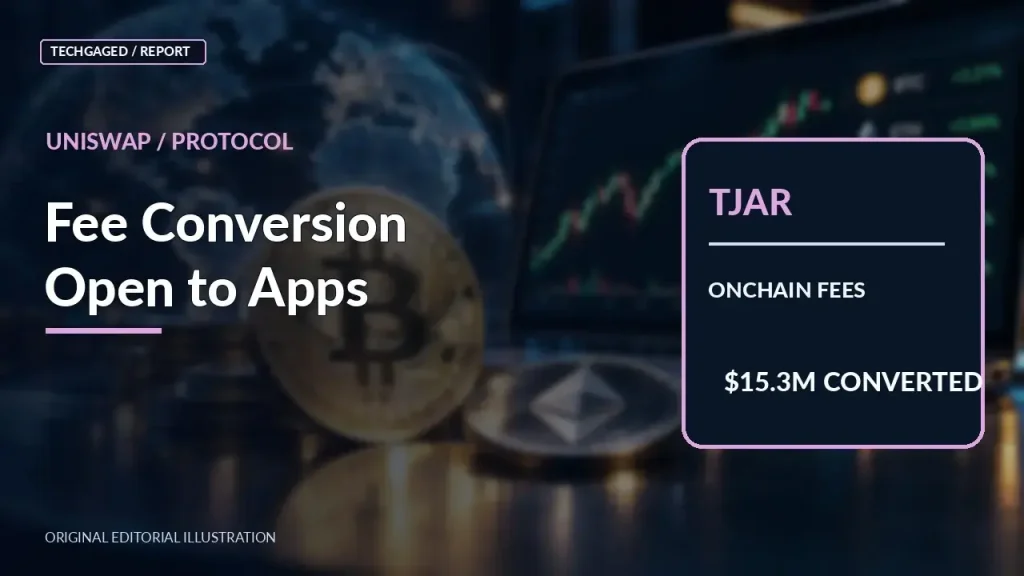
Uniswap TJAR onchain fee conversion editorial illustration
Uniswap has opened a fee-conversion mechanism developed for its own protocol to external applications, allowing businesses and onchain systems that collect payments in many assets to receive proceeds in a chosen token. The product, called TJAR, already operated within Uniswap’s protocol fee system before being offered more broadly.
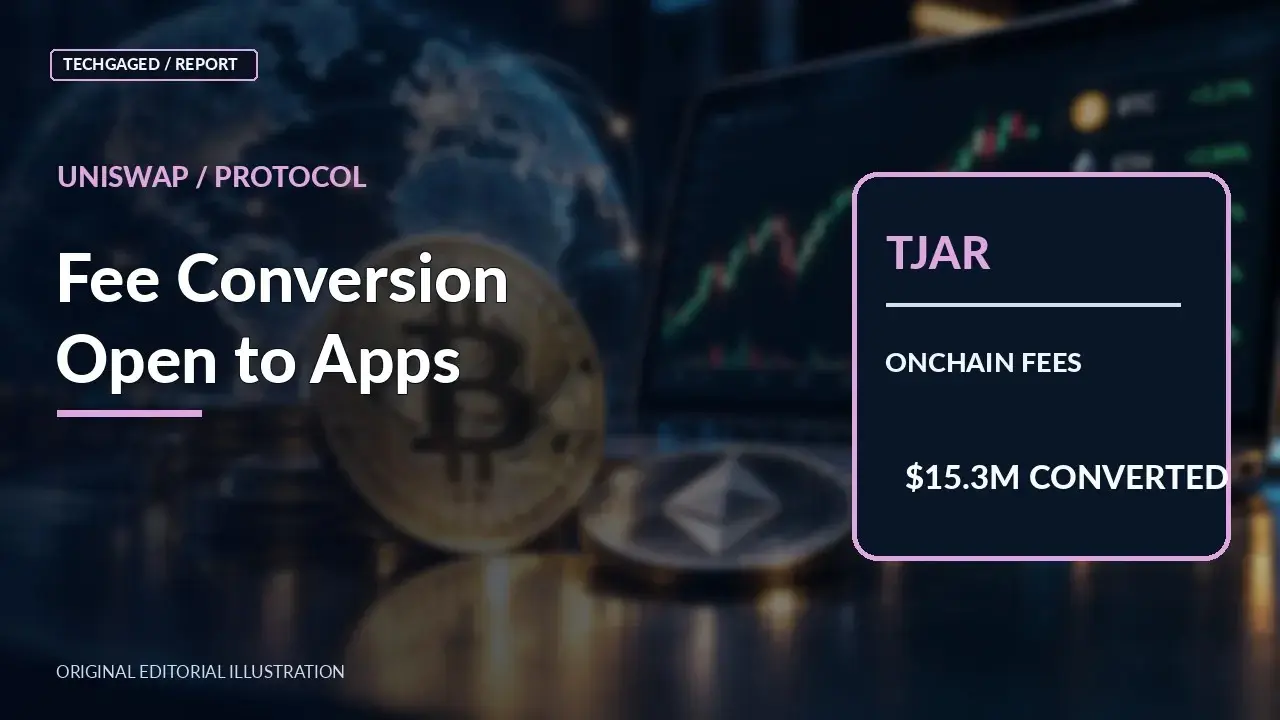
According to the October 29 announcement, TJAR handled more than $15.3 million in conversions during the previous month and is now deployed across seven blockchains. Uniswap says Robinhood uses the system for fees collected through the Uniswap API, receiving USDC and USDG through its own configured Token Jars.
The $15.3 million figure represents the reported value converted, not a profit earned by TJAR users or a guarantee of future monthly activity. The open-source service does not automatically make every illiquid token convertible at a good price.
Latest Stories
Polygon Opens TRON USDT Routing to Banks and Fiat Payout Networks

Abu Dhabi Asset Manager Uses Chainlink to Put Compliance Checks Into Token Transfers

Uniswap Gives Developers Live API Analytics After Reporting $2B in Routed Swaps
Turning many fee tokens into one
Applications may charge fees in whatever token a customer trades. Over time, that creates an inventory of many assets, some thinly traded or worth too little to justify an ordinary swap. Collecting those assets manually can involve repeated transactions and operational overhead.
TJAR accumulates fee assets in a contract and opens a market in which searchers compete to exchange a specified amount of the application’s chosen token for the contents of the jar. The application configures the destination and pricing parameters, while a searcher provides the specified settlement asset to release the collected tokens.
This arrangement transfers part of the conversion work to economically motivated counterparties. But because the effective price is configured, operators must monitor whether the jar’s offered conversion terms are competitive and whether assets are selling at an unacceptable discount.
Why it matters for app economics
Fee conversion can help protocols manage treasury reporting and liquidity when a product spans multiple chains. It also introduces governance choices about where proceeds go and whether the configuration can be changed or permanently locked.
Uniswap says the contracts have been audited by OpenZeppelin. An audit can identify many implementation risks, but it does not remove economic risks arising from mispriced jars, weak demand or malicious user interactions.
The mechanism also interacts with UNI protocol economics: Uniswap uses fee conversion in its own protocol process, where proceeds contribute to UNI burns. An outside application that adopts TJAR is not automatically making the same tokenomics decision; the receiving token and recipient can be configured independently.
This is an infrastructure product rather than a speculative token launch. Its significance will depend on whether developers can reduce fragmented fee balances without creating meaningful new losses through auctions or cross-chain operations.
How do you rate this article?
Subscribe to our YouTube channel for crypto market insights and educational videos.






Join our Socials
Briefly, clearly and without noise – get the most important crypto news and market insights first.
Most Read Today
1
Circle Opens CCTP to More Than USDC: A New Route for Issuer-Controlled Tokens
2OKX Adds Five Stock Perpetuals as Crypto Exchanges Push Further Into TradFi
3A Rare Ethereum Trend Is Emerging as Long-Term Holders Keep Taking Losses
4Akash Plans One-Way AKT Migration to Solana With a Two-Year Claim Window
5Binance Publishes Verifiable Reserves for 10 Tokens After $6.3B Hack
Latest





8
Also read
Similar stories you might like.

Industry
Uniswap Gives Developers Live API Analytics After Reporting $2B in Routed Swaps
TechGaged | 2026-11-02
Defi
Aave V4 Passes $1.5B in Deposits as External Curated Markets Expand
TechGaged | 2026-11-02

Altcoins
Cardano DEX Volume Jumps 143% in a Week as DeFi TVL Rebounds
TechGaged | 2026-10-06
Crypto News
Aave Moves to Raise GHO Borrowing Costs as Stablecoin Liquidity Gets Tight
TechGaged | 2026-10-04

Crypto News
Tokenized Gold Is Flowing Into DeFi — Tether Gold Crosses $100M
Azeez | 2026-09-02

Crypto News
Smart Money Is Starting to Look at DeFi Again
Azeez | 2026-08-31

Crypto News
Is DeFi Really Dead After This Brutal 50% Crash?
Azeez | 2026-08-19
Blockchain
Aave DAO Weighs Proposal for App Integrating Fiat, Self-Custody Lending
Rokas | 2026-07-15

Blockchain
Compound to Deprecate Polygon, Unichain Comets Due to Low Usage
Rokas | 2026-07-10

Blockchain
Chainlink Price Jumps 5.7% in 24 Hours, Outperforming Peers
Rokas | 2026-07-02