







KR1 dedicated Lido Ethereum staking validators server racks
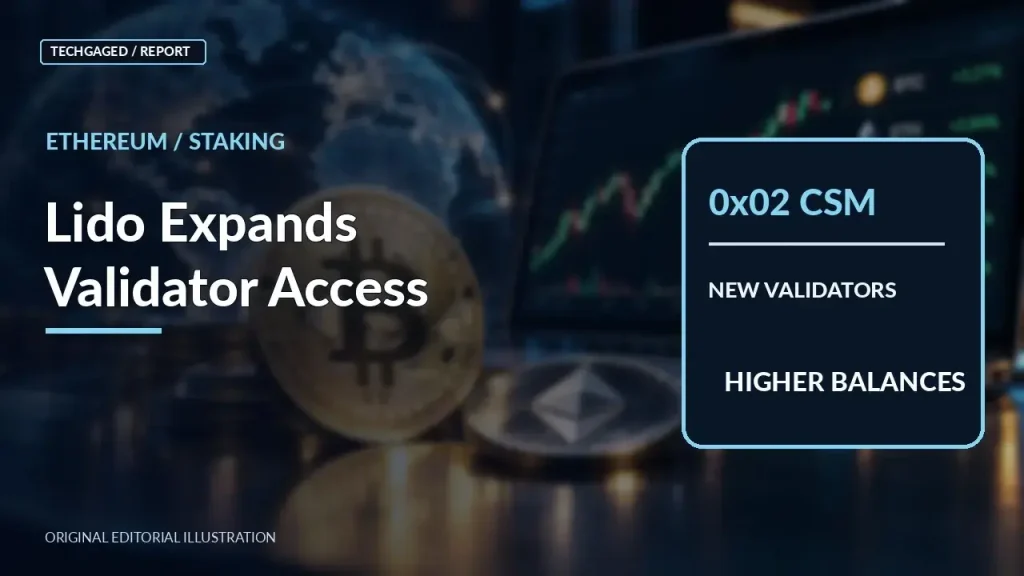
London Stock Exchange-listed digital-asset investor KR1 has launched dedicated Ethereum validators using Lido’s stVault infrastructure, with the company targeting as much as 6,000 ETH in staking in the near term. The arrangement highlights a growing institutional preference for tailoring validator operations rather than simply depositing assets into one shared liquid-staking pool.

According to the October 15 announcement from Lido, KR1’s validators are operated by P2P.org within a dedicated stVault. KR1 retains control over deposits and withdrawals, fee arrangements and the roles and permissions governing the vault, while holding the option to mint stETH against staked assets if it needs onchain liquidity.
The distinction between a target and an achieved amount is important. KR1’s stated near-term ambition is to stake up to 6,000 ETH; the release should not be read as independent confirmation that the entire amount has already been deposited, activated as validators or converted to stETH.
Latest Stories
Abu Dhabi Asset Manager Uses Chainlink to Put Compliance Checks Into Token Transfers

Uniswap Gives Developers Live API Analytics After Reporting $2B in Routed Swaps
Circle Gateway Adds EURC and Wrapped Bitcoin as Multi-Asset Settlement Expands
Why dedicated validators change the institutional trade-off
In traditional solo staking, an institution can exert greater control over validator operations but must manage signing infrastructure, monitoring, rewards and withdrawal processes. Delegated or pooled staking can reduce these operational demands, although it introduces reliance on infrastructure managers and protocol-level rules.
With a dedicated stVault, KR1 can specify a validator service relationship while still accessing Lido’s wider system. The structure allows an institution to allocate particular validator keys and manage operating permissions instead of relying solely on the defaults of an undifferentiated pool. P2P.org supplies the validator operations, but KR1’s ownership and financial exposure do not vanish merely because a provider manages the machines.
Liquidity is the second part of the proposition. The ability to mint stETH against eligible staked assets may allow an institution to deploy an onchain representation of its stake into other approved financial activities without waiting for the Ethereum validator exit queue. This does not make ETH staking completely liquid in every market or eliminate the risks of holding stETH and using it as collateral.
Market liquidity, exchange price, redemption mechanisms and borrowing limits can all matter if an institution needs cash at short notice. A vault’s capacity to create stETH is therefore only one component of a broader treasury policy.
What a professional investor needs to check
Validator performance remains central to the return. Proposer and attestation rewards fluctuate, and penalties or slashing can affect results. A dedicated operator can improve customization, but an institutional investor still needs evidence of uptime, key security, disaster recovery and independent controls over withdrawal credentials.
Governance and smart-contract risk also persist. A vault owner should understand whether administrators can change permissions, how minting rights work, whether the protocol can pause specific operations and what events would trigger emergency controls.
Unlike a contractual interest payment, ETH staking rewards depend on network conditions and operating performance. Calculated annual percentage yields cannot be promised as fixed investment returns. In a custodial relationship, additional legal and counterparty considerations may apply.
KR1’s decision provides a concrete example of staking infrastructure being adapted to the compliance and control requirements of publicly traded companies. The next significant evidence will be the actual amount staked, the measured validator performance and KR1’s disclosures about how it uses any liquidity unlocked through stETH.
For investors comparing yield-bearing crypto structures, TechGaged’s staking return checklist outlines the difference between a displayed yield and realized returns after operational, liquidity and price risks.
How do you rate this article?
Subscribe to our YouTube channel for crypto market insights and educational videos.






Join our Socials
Briefly, clearly and without noise – get the most important crypto news and market insights first.
Most Read Today
1
Circle Opens CCTP to More Than USDC: A New Route for Issuer-Controlled Tokens
2OKX Adds Five Stock Perpetuals as Crypto Exchanges Push Further Into TradFi
3A Rare Ethereum Trend Is Emerging as Long-Term Holders Keep Taking Losses
4Akash Plans One-Way AKT Migration to Solana With a Two-Year Claim Window
5Binance Publishes Verifiable Reserves for 10 Tokens After $6.3B Hack
Latest