






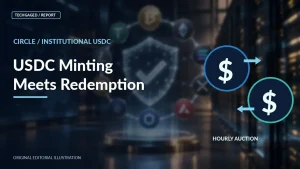
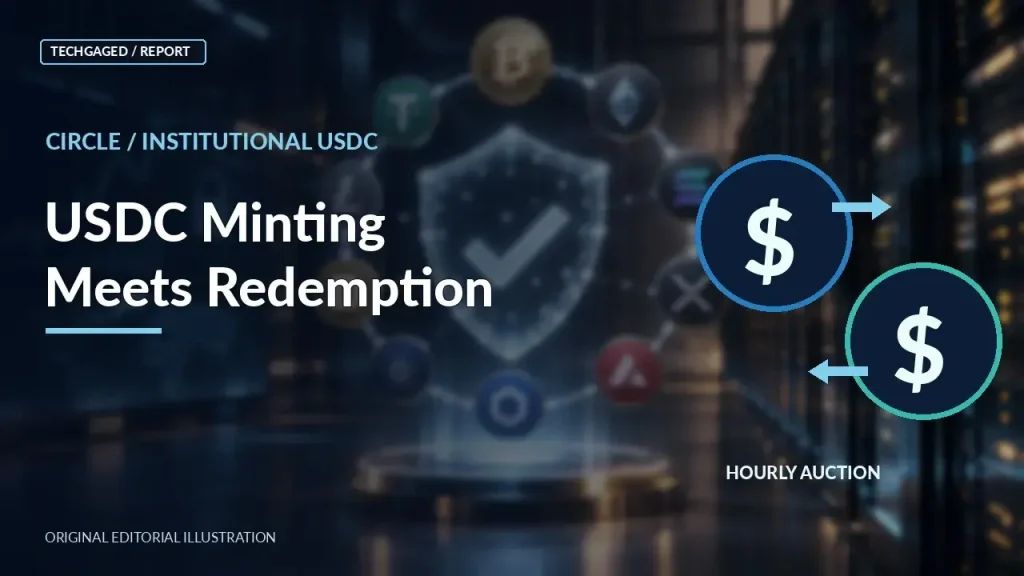
Circle Match hourly USDC auctions; original editorial illustration
Circle has introduced an hourly auction system for eligible institutional clients to match USDC minting and redemption orders inside Circle Mint. The service changes how some large stablecoin users may pay for or benefit from primary-market liquidity, but it does not change USDC’s stated one-dollar reference value.
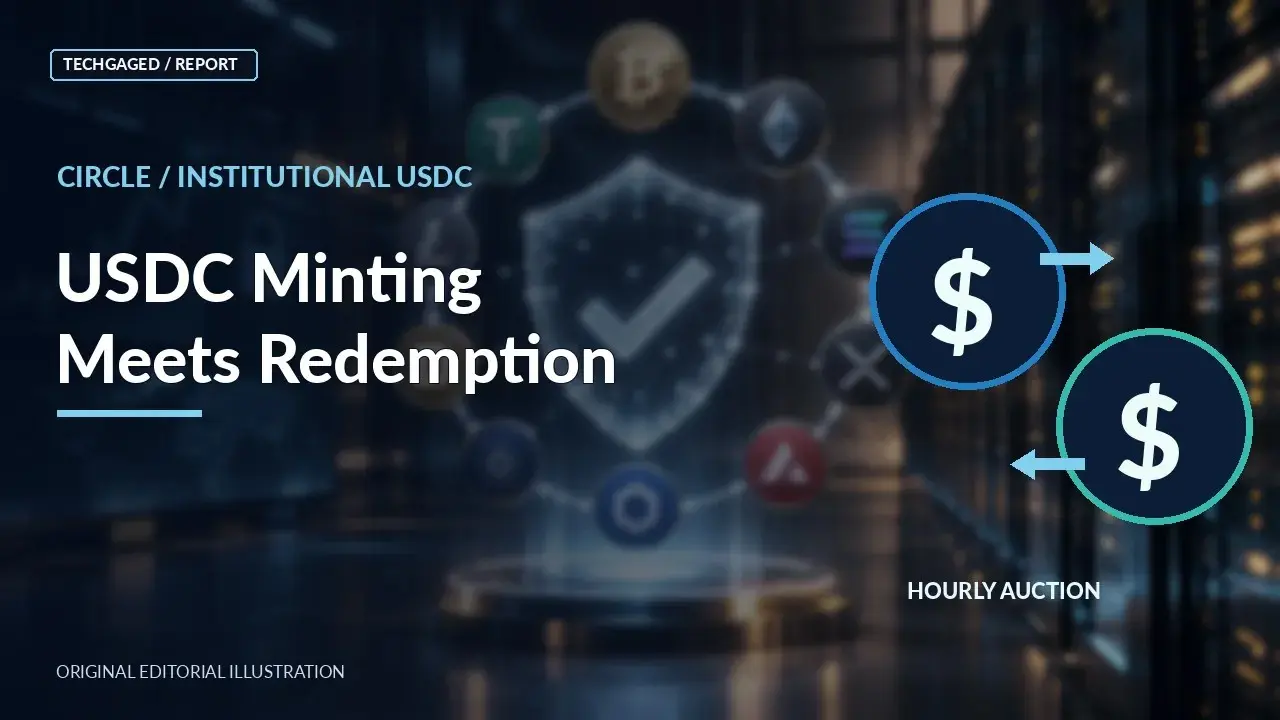
Circle’s October 22 product announcement says Circle Match brings together participants who want to create USDC with U.S. dollars and those who want to redeem USDC for dollars. Mint-side participants may receive a rebate when matched; redeemers pay a uniform auction fee that cannot exceed their own stated maximum or the standard Express redemption fee.
The service is available to eligible Circle Mint customers. Ordinary retail wallet users should not assume they can use it, and the company says availability varies by jurisdiction and account approval.
Latest Stories
Polygon CDK Besu Connects Private Bank Chains to Public Liquidity With ZK Proofs

Ripple and C2FO Propose XRP Ledger Settlement for Approved Invoices
Uniswap Opens TJAR Fee Conversion to Any App After $15.3M Monthly Trial
How the auction replaces separate primary-market flows
Ordinarily, a market maker needing USDC may mint it from the issuer while another trader is simultaneously redeeming the token. If those flows do not meet directly, participants may pay fees or spreads through other liquidity venues. Circle Match attempts to pair them in a prefunded, one-hour market where both sides specify the economic terms they accept.
Minters fund a separate balance using dollars and set the minimum rebate they will accept. Redeemers deposit USDC and specify the maximum fee they are willing to pay. Orders become subject to a one-minute lock before clearing; Circle says better-priced orders take priority while those at the clearing fee are allocated proportionally.
Matched participants settle at one uniform fee. Circle says the redemption side pays that fee and, currently, the minting side receives it as a USDC rebate, subject to product terms. The amount of any rebate depends on matched demand and is not a fixed yield or guaranteed profit.
Unmatched orders may follow instructions to roll forward, cancel or use another available Circle Mint route. This matters because an order can fail to match even when one side has deposited capital in advance. Users must account for the opportunity cost of tying up funds until an auction clears or they take another action.
A stablecoin liquidity mechanism, not an investment product
The innovation is mainly market microstructure. Matching offsetting primary-market flows can reduce friction when there are large institutional demands to create and redeem the same instrument. It does not eliminate the issuer’s reserve obligations or credit risk, nor should it be compared to bank deposit interest without examining the terms.
Circle Mint is not a bank account, and Circle expressly states that balances are not protected by ordinary deposit-insurance schemes. Participants need to understand who holds prefunded money, which entity owes redemption, and how fees apply when an order does not match.
For the broader USDC market, the real test is whether auction activity becomes deep and consistent enough to improve institutional execution. Circle has described the mechanics but not yet established an independently measured reduction in industry-wide conversion costs. Volume, average clearing fees and repeated participation would provide stronger evidence.
Unlike speculative stablecoin narratives, this is an observable product change: an issuer has introduced a specific mechanism to connect supply and redemption demand. Its benefits will be determined by usage and market quality rather than by marketing descriptions of potential savings.
How do you rate this article?
Join our Socials
Briefly, clearly and without noise – get the most important crypto news and market insights first.
Most Read Today
1
Circle Opens CCTP to More Than USDC: A New Route for Issuer-Controlled Tokens
2OKX Adds Five Stock Perpetuals as Crypto Exchanges Push Further Into TradFi
3A Rare Ethereum Trend Is Emerging as Long-Term Holders Keep Taking Losses
4Akash Plans One-Way AKT Migration to Solana With a Two-Year Claim Window
5Binance Publishes Verifiable Reserves for 10 Tokens After $6.3B Hack
Latest





8
Also read
Similar stories you might like.
Industry
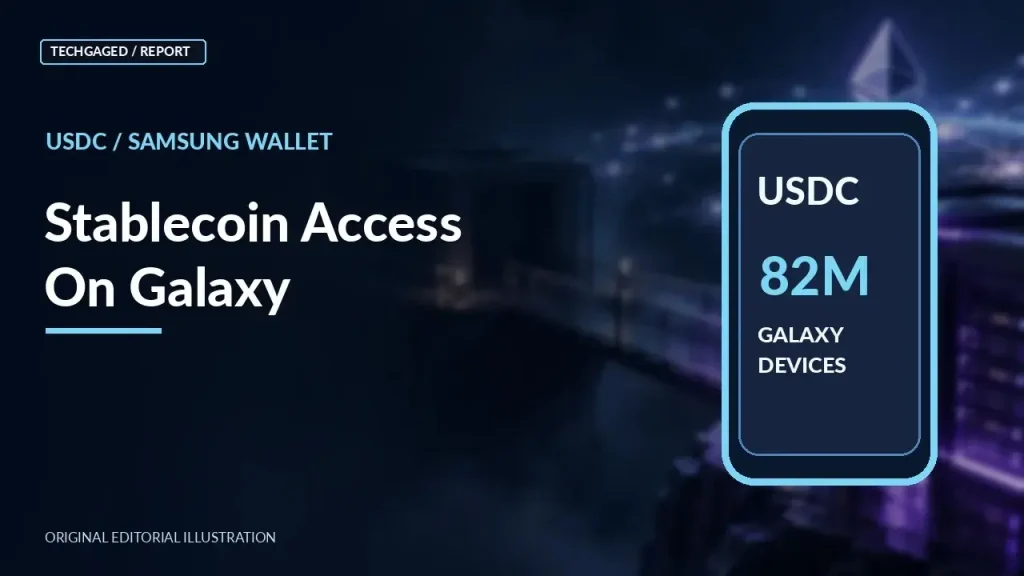
Samsung Wallet’s USDC Plan Reaches 82M Galaxy Devices, but Access Isn’t Automatic
TechGaged | 2026-11-02

Industry
Coinbase Prediction Markets Cross $200M Run Rate as Q3 Reveals Softer Crypto Trading
TechGaged | 2026-11-02
Blockchain
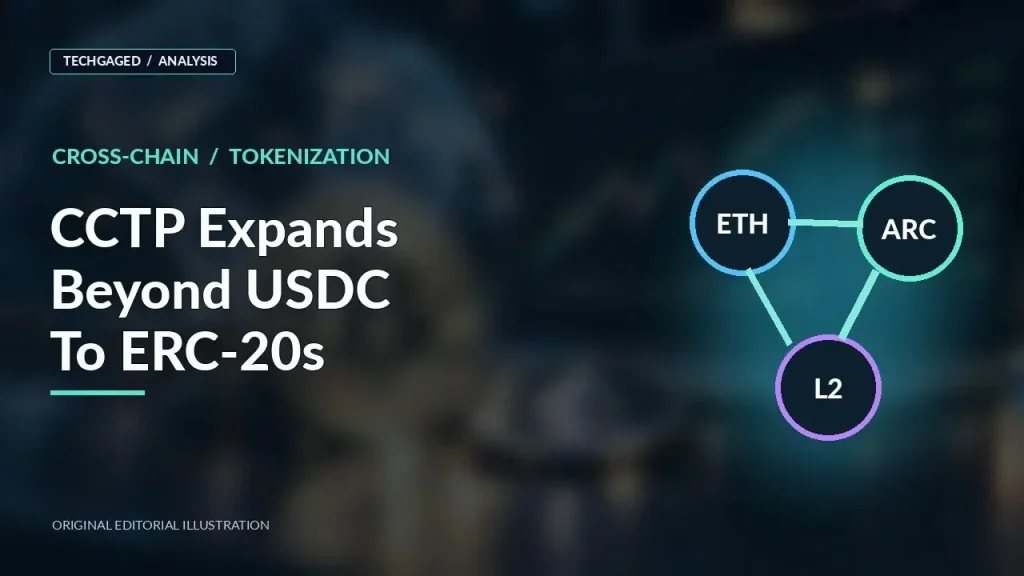
Circle Opens CCTP to More Than USDC: A New Route for Issuer-Controlled Tokens
TechGaged | 2026-11-02
Regulation
Circle Wants Qualifying Stablecoins Treated as Cash Under SEC Proposal
TechGaged | 2026-11-02
Crypto News
Wall Street Giant BNY Bets Bigger on USDC
Ana | 2026-06-30
Crypto News
$12.6M Freeze Sparks Fears as Circle Blacklists DeFi Contract
Rokas | 2026-06-01
Defi
How Stablecoins Became a $320 Billion Treasury Powerhouse
Ana | 2026-05-26

Altcoins
Meta Launches USDC Payments for Colombian and Filipino Creators, More Coming
Rokas | 2026-04-30
Altcoins
The Consensus Countdown Has Started — Here’s What Miami’s Monster Week Means for Crypto
Azeez | 2026-04-28

Altcoins
Tokenized Real-World Assets Already Reached $27B — Why This Still Matters for Crypto’s Future
Azeez | 2026-04-17