






Polygon completes Coinme acquisition editorial illustration
Polygon Labs has completed its acquisition of Coinme, integrating regulated US payment capabilities into its Open Money Stack platform. The transaction strengthens the financial-services layer around the Polygon ecosystem rather than changing the consensus rules or security guarantees of Polygon Chain itself.
In the October 14 announcement, Polygon says Coinme’s licensed money-movement services will support products connecting bank accounts, cards, cash funding and cryptocurrency settlement. The company named Tazapay, Mesh, Toku and Kira among the early adopters of the integrated platform.
Polygon’s description presents the transaction as complete, not pending regulatory approval. Nevertheless, a completed corporate acquisition does not automatically authorize every product in every US state or other country. Customers must still check the relevant service provider and permitted payment corridors.
Latest Stories
Unichain Moves Toward OP Enterprise With Native Cross-Rollup Transfers Planned

Chainlink’s Vault Adapters Open One DeFi Vault to Deposits From 80+ Chains
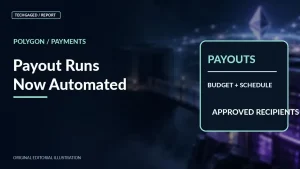
Polygon Automates Stablecoin Payouts With Recipient and Budget Controls
The problem with crypto-only payments
For a business, receiving a stablecoin is not always enough. It may need to pay suppliers, employees or customers through local bank accounts, deliver refunds or reconcile balances denominated in fiat currency.
Those requirements involve banking partners, regulated payment intermediaries, identity verification and transaction monitoring. A blockchain can settle a token quickly but cannot independently create a bank payout obligation or guarantee cash delivery.
By combining onchain infrastructure with Coinme’s money movement capabilities, Polygon is trying to make stablecoin payment integrations easier for developers who would otherwise assemble several third-party services.
Why regulated access still depends on operations
Licensing and regulatory relationships can lower some adoption barriers for enterprise clients, but they do not eliminate operational risk. A company needs to know which legal entity holds customer funds, how payments are authorized and what happens when a fiat payment fails after an irreversible blockchain transfer.
Users also need clear fee disclosure. A “low-cost blockchain” payment could still carry an unfavorable currency conversion rate, off-ramp fee or recipient charge that makes it less competitive than a conventional alternative.
The payment stack’s expansion may benefit stablecoin use beyond speculation, including supplier payments and cross-border transfers. But the existence of a licensed provider says little about how many customers will actually use the integrated product.
For investors, the relevant milestones are operating adoption, transparent economics and evidence that businesses can reconcile funds reliably across fiat and onchain systems. The deal is concrete, but it does not justify an automatic price prediction for POL or any other token.
How do you rate this article?
Subscribe to our YouTube channel for crypto market insights and educational videos.






Join our Socials
Briefly, clearly and without noise – get the most important crypto news and market insights first.
Most Read Today
1
Ripple Wins Final US Trust Bank Approval, but RLUSD Issuer Remains Unchanged
2S&P Global Ratings Brings DeFi Vault Risk Assessments Onchain Through Chainlink
3Hanwha Selects Chainlink for Global Tokenized Assets Ahead of Korea’s 2027 Rules
4Circle Opens CCTP to More Than USDC: A New Route for Issuer-Controlled Tokens
5EU Crypto Firms Face Deadline to Unwind Non-MiCA Stablecoin Exposure
Latest



8
Also read
Similar stories you might like.
Security
Polygon Adds Spending Limits for AI Agents Paying With Stablecoins
TechGaged | 2026-11-02
Industry
Polygon Automates Stablecoin Payouts With Recipient and Budget Controls
TechGaged | 2026-11-02

Defi
Euro-to-Dollar Stablecoin Swaps Go Live on Polygon Through Monerium and Frax
TechGaged | 2026-11-02
Industry
Polygon Opens TRON USDT Routing to Banks and Fiat Payout Networks
TechGaged | 2026-11-02
Blockchain
Polygon CDK Besu Connects Private Bank Chains to Public Liquidity With ZK Proofs
TechGaged | 2026-11-02
Defi
Arbitrum Offers ARB Rewards to Protocols Building USDG Stablecoin Liquidity
TechGaged | 2026-11-02
Industry
Polygon Open Money Stack Adds Solana for Full Bank-to-Stablecoin Payments
TechGaged | 2026-11-02
Industry
Samsung Wallet’s USDC Plan Reaches 82M Galaxy Devices, but Access Isn’t Automatic
TechGaged | 2026-11-02
Regulation
EU Crypto Firms Face Deadline to Unwind Non-MiCA Stablecoin Exposure
TechGaged | 2026-11-02
Regulation
US Stablecoin Rule Is Final, but Key GENIUS Act Requirements Start January 18
TechGaged | 2026-11-02